Repeating same scenarios weakens the actual response.
Real emergency preparedness often remain fragile, despite the regularly conducted drills. When drills are not systematically planned, executed, evaluated, and integrated into improvement processes, drills become a training routine that looks active but fails to build true emergency response capability.
Without structured drill architecture:
• Drills repeat familiar scenarios
• Focus is on regulatory compliance
• Drills provide limited operational learning
• Systemic weaknesses remain undiscovered
• Crews become habituated and real response capability degrades
Critical emergency situations remain untested, and systemic weaknesses remain hidden until a real incident occurs.
Continuously strengthening emergency preparedness.
Ilmarine helps maritime organizations transform emergency drills from routine exercises into a structured preparedness system.
• Systematically test the full range of emergency scenarios
• Develop coordinated response capability across departments
• Introduce realistic operational stress during exercises
• Evaluate performance through structured observation
• Convert drill outcomes into organizational learning
Clarity, predictability and confidence to your emergency response operations.
Structured and designed by operational experience.
Ilmarine is founded by a Chief Engineer with over a decade of operational experience at sea and formal Lead Auditor training in ISM, ISPS and MLC systems.
We understand both the written system and the reality of operations. Our approach is structured, proportionate and built around how emergencies actually unfold onboard and ashore. We've participated on countless emergency drills, and we know the reality and practice onboard.
How we can help you.

1.
Diagnostic Review
We conduct a structured assessment of your emergency drill and training architecture.
We evaluate:
• Drill planning
• Scenario coverage
• Drill realism
• Performance evaluation
• Learning integration
• Management oversight

2.
Structural Analysis & Recommendations
Based on the diagnostic results, we identify structural weaknesses within the drill program.
Typical improvement areas include:
• scenario coverage planning
• drill escalation logic
• training architecture
• performance monitoring
• learning feedback loops
• integration with management review processes

3.
System Development & Implementation
Where required, we support the design and implementation of improved drill architectures, including:
• emergency scenario libraries
• drill rotation models
• scenario escalation frameworks
• structured drill evaluation tools
• learning integration processes
Repeated, structured testing of the emergency response system.
Well-designed drill architecture ensures that emergency scenarios are systematically exercised, training complexity evolves over time, and drill outcomes lead to measurable improvement in system capability.
Without structure, drills often remain isolated exercises with limited operational impact. When properly designed, however, drills become one of the most powerful mechanisms for identifying weaknesses and strengthening the organization’s ability to respond under real operational pressure.
Ilmarine approach to emergency drill architecture.
Our approach evaluates the drill system across several structural domains:
1. Drill Planning & Scenario Architecture
Ensuring drills are planned systematically using defined scenario libraries and rotation logic.
2. Scenario Coverage Integrity
Verifying that the drill program exercises the full spectrum of emergency scenarios relevant to vessel operations.
3. Training & Competence Development
Ensuring emergency roles are supported by structured training and coordinated departmental response.
4. Drill Execution & Operational Control
Evaluating whether drills realistically simulate operational emergency conditions.
5. Performance Monitoring & Evaluation
Ensuring drills are observed, evaluated, and documented using structured criteria.
6. Learning Integration & System Improvement
Ensuring drill findings lead to improvements in procedures, training, and equipment.
7. Governance Oversight
Ensuring drill performance and preparedness trends are reviewed by management and integrated into the Safety Management System.
These elements together form a structured emergency preparedness architecture that continuously improves the organization’s response capability.
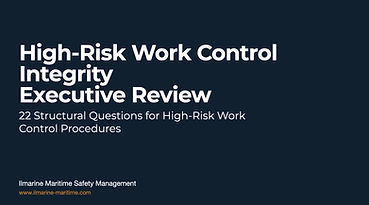
This executive-level diagnostic tool is designed for DPAs, technical managers, and operational leaders who want to evaluate the structural integrity of their high-risk work controls. The review focuses on ownership, verification, integration, and operational clarity instead of superficial compliance.
Start Strengthening Your Emergency Drills.
If your emergency drills are conducted regularly but you are unsure whether they truly test your response capability, a structured diagnostic review can reveal where the system may need strengthening.
Contact Ilmarine to discuss how your drill program can evolve from routine exercises into a structured preparedness architecture.
Proportionate to your operational complexity and system maturity.