When safety systems exist, but don’t truly control the work.
Poorly structured, complicated and fragmented high-risk work safety systems create predictable weaknesses. Generic risk assessments written once and copied since, permits that do not fully align with the actual work, and controls lacking verification and ownership, all erode the integrity of the system.
Managements visibility becomes blurred, while crews disengage from documented procedures and deviation gets gradually normalized. Compliance might remain on paper, but practice becomes uncertain. When an incident occurs, the organization is exposed not only operationally, but structurally to investigative and regulatory scrutiny.
When crews disengage from the system, the system begins to disengage from reality.
We redesign high-risk work systems around real operations.
We design integrated systems that connect: Hazard Identification → Control Definition → Work Authorization → Verification → Learning
With properly integrated system you will gain:
1. Structured Risk Thinking
Risk assessments become task-specific and require deliberate hazard identification.
2. Aligned Permit Architecture
Permits reflect how work is actually executed onboard.
3. Embedded Verification
Critical controls must be actively confirmed before authorization.
4. Clear Role Accountability & Crew Engagement
Each stage of the process has defined ownership and decision authority.
5. Restored Management Visibility
Superintendents and managers can see whether control integrity is functioning.
Strong systems reduce reliance on individual experience and increase reliability of control.
Built by engineers who have worked the risk.
Ilmarine is led by senior marine engineering experience with over a decade of operational background at sea. We understand time pressure, maintenance realities, crew competence variation, superintendent expectations and audit pressure.
We combine our operational experience with structured system design. We know the realities onboard, we know why systems drift, and we know how to realign them without overcomplicating the work.
How we strengthen your high-risk work system.

1.
Diagnose
We assess your current PTW & RA framework:
-
Architecture gaps
-
Role clarity
-
Verification weaknesses
-
Control integrity
-
Alignment with real tasks
Output: Structured gap overview.

2.
Redesign Core Controls
We rebuild or upgrade:
-
Risk Assessment methodology
-
Permit-to-Work structure
-
Isolation logic
-
Toolbox integration
-
Control verification steps
Output: Clean, integrated high-risk work package.

3.
Embed & Build Capability
We support implementation through:
-
Management alignment
-
Crew familiarization
-
Scenario testing
-
Emergency preparedness integration
-
Feedback loop integration
Output: System designed for actual use.
What you receive.
Depending on your needs, the engagement may include:
-
Structured High-Risk Work Manual
-
Integrated PTW templates (Hot Work, Enclosed Space, Working Aloft, etc.)
-
Risk Assessment methodology and scoring framework
-
Control libraries linked to hazard categories
-
Verification checkpoints embedded into permits
-
Clear RACI role structure
-
Management visibility tools
-
Implementation guidance material
-
Digital or paper-ready architecture
We can support:
-
Full system redesign
-
Upgrade of existing framework
-
Modular implementation
-
Advisory & review only
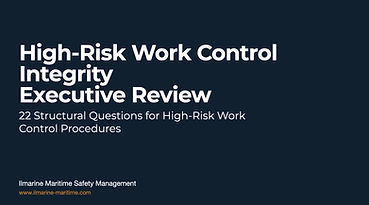
This executive-level diagnostic tool is designed for DPAs, technical managers, and operational leaders who want to evaluate the structural integrity of their high-risk work controls. The review focuses on ownership, verification, integration, and operational clarity instead of superficial compliance.