Most Safety Management Systems Look Complete on Paper, But Fail in Practice
What that means in reality:
-
Work is carried out differently on each vessel
-
Risk assessments exist, but don’t influence decisions
-
Procedures are followed formally, not operationally
-
Incidents repeat despite “corrective actions”
-
Management lacks real visibility of safety performance
-
Crews comply, but don’t fully trust the system
You don’t lose compliance. You lose control.
Fragmentation reduces operational clarity and increases exposure.
Gain Operational Clarity & Control With Our SMS Framework
We design SMS frameworks that connect how safety is managed, how work is executed, and how the organization learns and improves.
Not as separate procedures, but as one integrated system.
Our frameworks ensure that:
-
Risks are identified before work begins
-
Controls are applied during execution, not just documented
-
Performance is verified, not assumed
-
Incidents lead to real system improvements, not just reports
-
Management has clear visibility of what is actually happening
-
Your SMS will be digital ready
A system that works when it matters, not just during audits.
Practical Support Across Audits, Compliance, And System Development
Structured audits that verify compliance. And show how your system actually performs in practice.
Targeted System Improvements
Focused improvements where your system needs it most. Without unnecessary redesign.
Subsystem Development (Risk, Emergency, Learning, etc.)
Safety Management System Development
We design safety management systems that are practical, structured, and aligned with real operations.
Advisory & Support
Practical support when internal resources are limited or when decisions need clarity.
Designed by Operational Experience
With substantial experience as sea-going officers, we've been working inside the very systems we now help organizations to strengthen. We understand the frustration of systems that look good, but don’t function.
Most SMS frameworks evolve over time:
-
procedures added after incidents
-
forms created for audits
-
systems layered without structure
We don’t rewrite your manuals. We redesign the system behind them.
With a marine engineering and audit background, we focus on:
-
control integrity
-
operational usability
-
system architecture, not individual documents
How We Can Help You

1.
Map the Current System
First, we'll gain understanding how your SMS actually functions, not just how it is written

2.
Design the Framework Architecture
We'll structure the system into clear, integrated components.

3.
Build & Integrate the System
In case something critical is missing, we'll develop practical tools, workflows, and documentation that support execution.
What Our SMS Framework Actually Is
Our Safety Management System is not a collection of procedures. It is a structured operational system built around how safety is created, controlled, and improved across the organization.
At its core, the system answers fundamental operational questions:
-
Who is responsible for safety?
-
How are risks identified and controlled?
-
How is work executed safely?
-
How are incidents managed and learned from?
-
How does management know if the system is working?
These are not theoretical questions. Instead, they define how safety performs in practice.
The Structure:
10 Integrated Systems
Our framework is built around ten core systems that work together:
-
Governance & Safety Leadership
-
SMS Architecture & Documentation
-
Risk Management
-
Operational Control
-
Technical Integrity & Maintenance
-
Reporting, Investigation & Learning
-
Emergency Preparedness
-
Competence, Training & Manning
-
Assurance & Verification
-
Performance Monitoring & Continuous Improvement
Each system has:
-
a clear purpose
-
defined ownership
-
practical tools
-
structured workflows
But the real value is not in the individual systems.
It is in how they connect.
From Documents →
To Operational Control
Most SMS failures are not due to missing procedures.
They fail because:
-
Risk assessments are disconnected from execution
-
Permits exist but don’t control the work
-
Drills are not linked to real operational scenarios
-
Verification is weak or absent
-
Learning feedback don't actually feed back to procedures
Our framework is built around control integrity:
Risk → Control → Execution → Verification → Learning
Practical Tools & Deliverables
We don’t deliver abstract frameworks.
We deliver working systems, including:
-
Structured SMS architecture (clear hierarchy and logic)
-
Risk assessment systems (task-based, usable)
-
Permit-to-work systems (integrated with risk controls)
-
Operational procedures aligned with real tasks
-
Emergency response structures and drill architectures
-
Incident investigation and learning systems
-
Internal audit and verification tools
-
Performance monitoring dashboards and KPI structures
Each tool is designed to:
-
be usable onboard
-
support decisions under pressure
-
integrate into the wider system
Designed for Real Operations
Our systems are built for how work actually happens:
-
Time pressure
-
Imperfect conditions
-
Human limitations
-
Changing environments
That means:
-
Clarity over complexity
-
Usability over completeness
-
Structure over volume
If a system cannot be used onboard, it does not work.
Digital-Ready by Design
Most SMS digitalization fails because the system is not structured for it.
We design systems that are:
-
Modular
-
Structured
-
Logically connected
-
Workflow-compatible
This allows:
-
Smooth integration into SMS platforms
-
Automation of workflows (PTW, reporting, approvals)
-
Better data collection and analysis
-
Real-time management visibility
We don’t start with software. Instead, we build a system that can function inside one.
Why This Approach Is Different
Most providers:
-
Deliver documents
-
Focus on compliance
-
Optimize for audits
We focus on:
-
How work is actually controlled
-
How decisions are made onboard
-
How systems perform under pressure
Because safety is not created by documentation.
Instead, safety is created by structure, clarity, and execution.
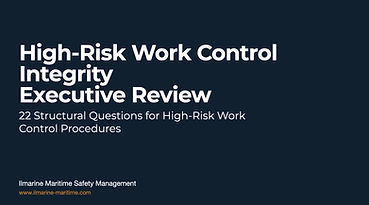
This executive-level diagnostic tool is designed for DPAs, technical managers, and operational leaders who want to evaluate the structural integrity of their high-risk work controls. The review focuses on ownership, verification, integration, and operational clarity instead of superficial compliance.