A Compliant SMS Can Still Fail In Practice
Poorly structured systems can cause multiple issues in practice. Even with compliant system:
-
responsibilities might feel unclear
-
procedures might not fully support real operations
-
risk controls might not be applied consistently
-
learning does not always translate into improvements
Signs of a poorly designed system:
-
Procedures exist, but they do not guide real work
-
Documents overlap, contradict, or leave gaps
-
Crews cannot quickly find what is relevant
-
Revisions are issued, but not truly implemented
-
Forms are completed, but do not prove control
-
The system grows, but operational clarity does not
-
Learning loops don't drive system upgrades
Over time, gaps start to emerge between paper and practice. This leads to crew disconnection from the documented procedures. Eventually, this disconnection will start to show up as audit stress and leave the management exposed during investigative scrutiny.
A system that looks sufficient on paper, but does not support safe decision-making in daily operations, will eventually fail.
Safety Management Is a System, Not a Library
Ilmarine supports maritime organizations in reviewing and strengthening the architecture and document control of their Safety Management System.
We design SMS architecture so that:
-
Every document has a clear role and position
-
Procedures actively control work, not just describe it
-
Forms and records provide real evidence of implementation
-
Structure supports both compliance and operational performance
-
The system can evolve without becoming fragmented
Our goal is simple:
A coherent, controlled, and operationally usable SMS.
Designed & Structured by Operational Experience
Ilmarine is founded by a Chief Engineer with over a decade of operational experience at sea and formal Lead Auditor training in ISM, ISPS and MLC systems.
We work alongside operators, DPA's, and technical teams to design safety systems that are practical and usable. We understand both the written system and the reality of operations. Our approach is structured, proportionate and built around how actual operational safety is achieved onboard and ashore.
We work alongside technical and safety teams to:
-
Map the actual structure of the SMS
-
Identify overlaps, gaps, and conflicts
-
Redesign the system into a clear, usable architecture
-
Align documentation with real operational workflows
We are not rewriting manuals.
We are restructuring the system that those manuals belong to.
How We Can Help You to Strengthen Your SMS Architecture & Documentation

1.
We Map the Current Architecture
To understand how your SMS is actually structured today.

2.
We Identify Structural Weaknesses
To reveal fragmentation, duplication, and usability issues.

3.
We Rebuild the System Logic
We restructure the documentation into a coherent, integrated architecture.
SMS Architecture as Interconnected Structural Systems, Not Individual Documents
Safety Management System is not defined by the number of procedures it contains. It is defined by how clearly it is structured, how well it is understood, and how consistently it supports operations.
Our framework consists of ten core elements:
1. SMS Structural Framework
Defines the overall architecture and system logic
2. Document Hierarchy & Classification
Clarifies what is policy, procedure, instruction, or record
3. Procedure & Control Design
Ensures procedures actually govern work in practice
4. Document Control & Revision Management
Maintains version integrity and controlled updates
5. Forms, Records & Evidence Structure
Ensures documentation proves implementation, not just existence
6. Accessibility, Usability & Distribution
Makes the system usable onboard, not just available
7. Cross-System Integration
Connects risk, operations, emergency, and learning into one system
8. Fleet Standardization & Local Adaptation
Balances consistency with operational reality
9. Documentation Quality Assurance
Maintains clarity, consistency, and usability over time
10. Continuous SMS Development
Ensures the system improves without becoming fragmented
These elements together define how the SMS functions as a whole system, not just how documents are written.
What You Could Receive:
Practical Outputs That Restructure Your SMS
In addition to restructuring the system, you will receive practical tools and outputs that make the architecture visible, usable, and maintainable.
Depending on the scope, we can deliver outputs such as:
SMS Architecture Map
A clear visual structure of your entire SMS, showing how systems, procedures, and controls connect
Structured Document Hierarchy & Index
A clean, logical classification of all documents, making it easy to understand what is mandatory, what supports it, and where everything belongs
Procedure Design Standards & Templates
Standardized formats that ensure procedures are clear, consistent, and operationally usable
Document Coding & Naming Logic
A coherent system that removes ambiguity and supports long-term control of documentation
Document Control & Revision Framework
Defined approval flows, version control logic, and revision governance to prevent system drift
Forms & Records Structure
Redesigned forms that support real control and produce meaningful evidence, not just signatures
Cross-System Integration Mapping
Clear linkage between risk assessments, procedures, permits, records, and learning systems
Accessibility & Navigation Structure
Improved SMS usability, so crews can actually find and use the system under real conditions
Fleet Standard vs Vessel-Specific Structure
Defined boundaries between what is standardized and what can be adapted locally
Documentation Quality Review Criteria
A clear standard for what “good documentation” actually means in your organization
SMS Development Roadmap
A structured path for future improvements, without fragmenting the system again
Most SMS Problems Are Not Caused by Missing Procedures
Most usability problems are caused by how the system is structured.
Without a defined architecture:
-
The SMS grows through patches rather than design
-
Controls are hidden inside text instead of made visible
-
Forms exist, but are not linked to decision-making
-
Subsystems operate in isolation instead of reinforcing each other
Over time, this creates a system that passes audits, but does not consistently control operations.
A well-designed SMS architecture changes this. Well-designed SMS architecture ensures that:
-
Structure supports how work is actually performed
-
Controls are clear, visible, and verifiable
-
Documentation is easy to navigate under real conditions
-
Changes can be implemented without breaking the system
-
SMS can be digitalized without issues
Properly structured SMS is the starting point for a system that people can actually use.
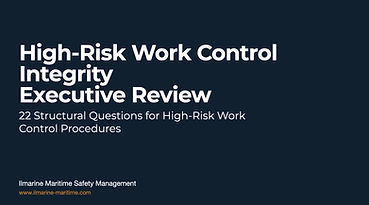
This executive-level diagnostic tool is designed for DPAs, technical managers, and operational leaders who want to evaluate the structural integrity of their high-risk work controls. The review focuses on ownership, verification, integration, and operational clarity instead of superficial compliance.